
This will cost the government Rs 3.1 trillion, about 10 per cent of its annual expenditure, and higher than any other spending item in its Budget.

In a paper, EAC-PM accused Subramanian of "cherry-picking high-frequency indicators" to express his skepticism about the growth rates after 2011-12.

Indian Oil Corp (IOC) is deploying drones to monitor its vast network of pipelines across the country as it doubles down on the use of technology to thwart attempts to steal fuel, helping not just save the commodity but also avoid accidents. The country's top oil company already uses a combination of sophisticated technology and patrolling to detect any leakage from the pipeline network spanning over 15,000-kilometers. And now, it is adding drones to monitor the vast network, officials said. Use of technology helped throttle 34 attempts to pilfer fuel and arrest 53 persons in the 2020-21 fiscal year, they said adding the latest incident was in Sonipat, Haryana on August 17.

Rajan also said the outlook for agriculture is subdued, in view of both rabi and kharif prospects being hit by monsoon vagaries.

Policy discussions now should urgently focus on the road map for serious economic and institutional reforms to put India on a sustained high growth trajectory like the Chinese economy, says Jayanta Roy.

'It is not simply demonetisation or GST, it is this government's failure to manage the financial sector crisis.'
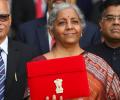
Had Finance Minister Sitharaman thought a little more about the middle class, disadvantaged sections, and the poor who are struggling, it would have been an inclusive Budget that would have made history, notes Ramesh Menon.

India's work participation rate is lower than Pakistan and Bangladesh. Are Indians lazy? No, there are no jobs, asserts Aakar Patel.

He attacked the dispensation over issues such as the state of the economy, the situation in Kashmir, the National Register of Citizens in Assam and action by probe agencies against opposition leaders.

'One cannot take it that the economy has recovered, and the GST payment has increased because of that, or that production is back to January 2020 level.'

The senior Congress leader also said over 90 per cent of jobs are in the SME sector which requires an urgent push to boost the economy.

Rural and urban regions present different labour participation and employment levels. These differences also are not tuned to India exploiting its demographic dividend, says Mahesh Vyas.

'Young professionals should be open for jobs in adjacent industries, pick up a contract job to have an opening balance, develop skills in the job in hand, invest in learning and develop cognitive skills and capacities.' 'Spend as per the need only.'

The government must realise that it has very little time to recover itself, its reputation, its legacy - and India's fortunes,says Mihir S Sharma.

'If the 7 million estimate is true, then either our understanding of the past was all wrong or the economy has changed dramatically but so surreptitiously that we did not even notice it,' says Mahesh Vyas.

'I'm pitching India for the strengths we offer, including the English language, engineers, doctors, nurses, professionals, innovative talent of startups.'

Mandates have been handed out to staffing solutions companies such as Randstad India and TeamLease, officials at these firms have said, as players increasingly push into rural areas to capitalise on the uptick in the hinterlands.

'Unemployment barely figures in the Budget except as a derived demand from the industry and infrastructure.' 'There is no effort at direct attack on unemployment.'

'People are getting back to work.' 'The worst seems to be over.' 'It is very likely that the recovery is mostly among the informal, self-employed, workers who cannot afford to be away from work for too long,' notes Mahesh Vyas.

He said it was not only a tax reform but 'is a measure that lends strength to the new culture of honesty'.

India's services sector activity witnessed a sharp upturn in August on the back of stronger gains in new business, ongoing improvements in demand conditions and job creation, a monthly survey said on Monday. The seasonally adjusted S&P Global India Services PMI Business Activity Index rose from July's four-month low of 55.5 to 57.2 in August, amid a quicker upturn in business activity and the sharpest rise in employment for over 14 years. For the thirteenth straight month, the services sector witnessed an expansion in output.

Several opposition members, including from the Dravida Munnetra Kazagham and the Communist Party of India-Marxist, also pointed out that the government took almost two months to impose the lockdown after the first case came to light in January, and claimed the delay had proved costly.

US President Barack Obama said there is natural convergence between India and the United States.

Rather than a blind reproduction of the government template, a more productive way of enforcing affirmative action in the private sector could be to emulate an American model, suggests Kanika Datta.

The study says the entire supply chain of goods and services will suffer a massive liquidity shock.

'Some people even boldly ask for a 100% increase in the salary.'

We will find it difficult to exceed an average of 5 per cent growth in the medium term, warns Shankar Acharya, the former chief economic adviser.

The central government's deposits with the RBI had fallen to just Rs 100 crore as of June 8.
Rising unemployment rate reflects a rise in the labour participation rate, which in India's case has been worryingly low.

'The roadmap ahead seems very difficult especially in the rural areas where there is very poor infrastructure, vaccine reach and hesitancy.' 'These are a deadly cocktail for the next wave.'

The employment that is returning is mostly essential services required by Indian households. Most urban Indian households cannot function without a retinue of maids, cooks, drivers, cleaners, notes Mahesh Vyas.
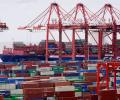
After staging a strong recovery from COVID-induced slowdown in 2021, India's exports are likely to extend the growth story to the New Year also on increased demand in the global markets, boost in domestic manufacturing due to production-linked incentive schemes and implementation of some interim trade pacts. Expectations of positive growth in the country's exports are also backed up by the outlook of the World Trade Organisation (WTO) which predicts a 4.7 per cent expansion in the global merchandise trade volume in 2022. Exporters believe that the outbound shipments would cross $400 billion mark in this fiscal going by the current momentum and may reach $475 billion in 2022-23.

The substantially increased economic dualism may exert lasting negative influences which could include a reduced potential for economic growth; the persistence of a very weak employment and poverty situation; rising social and political discord; and heightened vulnerability to geopolitical challenges, cautions Shankar Acharya, former chief economic adviser to the Government of India.

'Our first great challenge is to create 12 million new jobs each year, to make the demographic dividend an economic dividend.' 'We are nowhere near that,' points out Mohan Guruswamy.

'Usually, urban wage rates are 50 per cent higher than rural wage rates. But, this could be narrowing very rapidly now,' points out Mahesh Vyas, CEO, Centre for Monitoring Indian Economy.

'Two consecutive quarters of negative growth are the technical definition of an economic recession, and for the first time in this generation's memory, we may be staring at one,' observes Aakar Patel.

The country's demographic dividend is dissipating, with seriously adverse consequences for young India, asserts Shankar Acharya, former Chief Economic Adviser to the Government of India.

This whirlwind of activity only confirms that rushing around creating an impression of pompous busy-ness is not the same thing as solving problems, argues Mitali Saran.

India's economic image is not affected due to Adani Group's recent decision to pull out Rs 20,000 crore FPO (follow-on public offers) amid allegations of financial wrongdoings, Finance Minister Nirmala Sitharaman said on Saturday.
It's high time we now turn the popular question on its head -- when there is no growth in jobs for several years, how can the real GDP grow at 7 per cent per annum, says Mahesh Vyas.
